Facial Paralysis & Stroke: The Connection Emergency Rooms Take Seriously
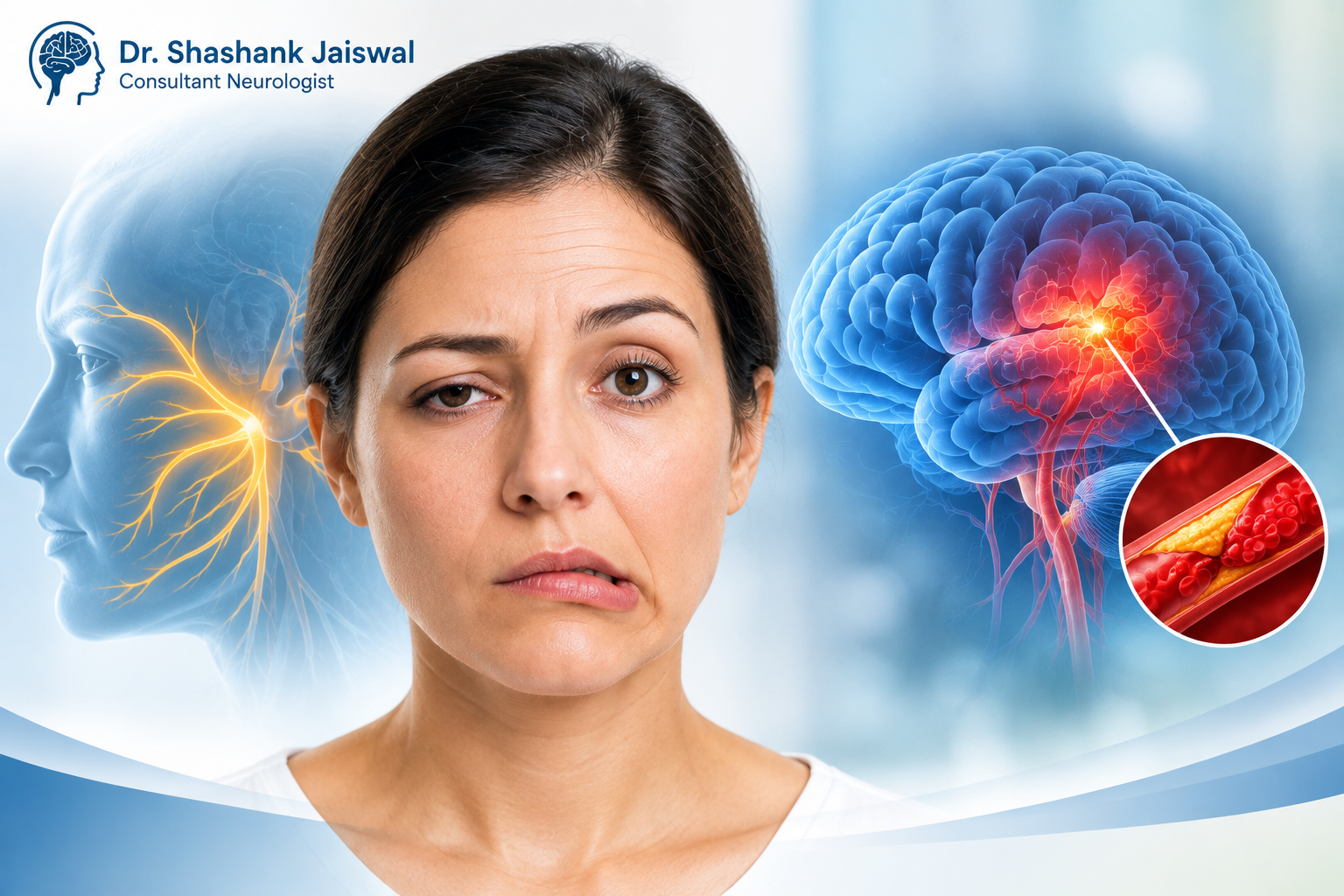
Facial paralysis and stroke: A drooping face is one of the most recognizable stroke warning signs — it’s the “F” in F.A.S.T. for a reason. But here’s the twist that makes this topic genuinely important rather than a simple checklist item: the very same symptom, one-sided facial paralysis, is also the hallmark of Bell’s palsy, a condition that has nothing to do with the brain at all and isn’t life-threatening. Telling the two apart quickly is one of the more difficult, high-stakes judgment calls in emergency medicine — difficult enough that even experienced clinicians sometimes order extra testing just to be sure.
Facial Paralysis and Stroke
Quick self-check: If sudden facial drooping appears, notice what else is happening
- Can you still wrinkle your forehead and raise your eyebrows on the affected side?
- Is there any arm or leg weakness, slurred speech, or trouble understanding words?
- Are there vision changes, dizziness, or loss of coordination alongside the facial change?
- Did the weakness develop over minutes to a couple of days, and is it affecting only the face?
These questions map onto a real anatomical distinction — and knowing it could genuinely matter in an emergency.
Why the Same Symptom Has Two Very Different Causes
Facial movement is controlled by the seventh cranial nerve (the facial nerve), but the brain’s wiring to that nerve has a quirk worth understanding: the upper face — your forehead and ability to blink — receives nerve signals from both sides of the brain, while the lower face receives signals from only one side. That redundancy is exactly why the two conditions can look different despite affecting the same nerve pathway.
Bell’s palsy results from inflammation or compression of the facial nerve itself, after it has already exited the brain — a peripheral problem. Because the nerve itself is damaged, it affects the entire side of the face equally, upper and lower, which is why someone with Bell’s palsy typically cannot wrinkle their forehead or fully close their eye on the affected side.
Stroke, when it affects the brain’s cortex, damages only the crossed pathway serving the lower face — leaving the dual-wired upper face intact. This is why classic cortical stroke often causes drooping around the mouth while sparing the forehead, and it’s the single most cited bedside distinguishing sign between the two conditions.
The Trap Worth Knowing About
Reflect for a moment: Notice that the explanation above hinges on the word “cortical.” That qualifier matters more than it seems.
Not all strokes happen in the brain’s outer cortex. Strokes affecting the brainstem — specifically the pons, where the facial nerve’s own nucleus sits — can damage the nerve pathway before that dual-wiring redundancy applies, producing complete one-sided facial paralysis that looks, in isolation, exactly like Bell’s palsy. Documented case reports have described pontine strokes presenting as isolated facial nerve palsy with no other findings on initial exam, closely mimicking Bell’s palsy and delaying accurate diagnosis. This is precisely why forehead-sparing, while a genuinely useful sign, isn’t an infallible one on its own.
How Clinicians Actually Tell Them Apart
Beyond the forehead test, emergency evaluation focuses on associated findings: brainstem strokes typically affect multiple cranial nerves or sensory and motor pathways simultaneously, producing accompanying symptoms — dizziness, double vision, slurred speech, limb weakness, or difficulty swallowing — that isolated Bell’s palsy does not. When there’s genuine diagnostic uncertainty, brain imaging (CT or MRI) can directly assess for ischemia, while MRI with contrast can reveal inflammation specific to the facial nerve consistent with Bell’s palsy instead.
Why This Distinction Genuinely Changes Outcomes
Time-sensitive stroke treatments only work within a limited window. Assuming facial drooping is “just Bell’s palsy” without a proper evaluation risk exactly the kind of delay that costs the most in stroke care — while, conversely, unnecessarily alarming a genuine Bell’s palsy patient with excessive testing has its own costs. Both directions of error are avoidable with a prompt, structured evaluation rather than guesswork in either direction.
The Bottom Line
Facial paralysis deserves emergency evaluation every time it appears, not because it’s always a stroke, but because distinguishing a stroke from Bell’s palsy reliably requires a clinical exam most people can’t safely perform on themselves — especially given that brainstem strokes can convincingly mimic the condition that seems more reassuring.
Facial paralysis and stroke – one thing worth remembering: if sudden facial drooping appears — regardless of how confidently it “looks like” Bell’s palsy — treat it as a reason to seek emergency evaluation immediately, not a reason to wait and watch.
