
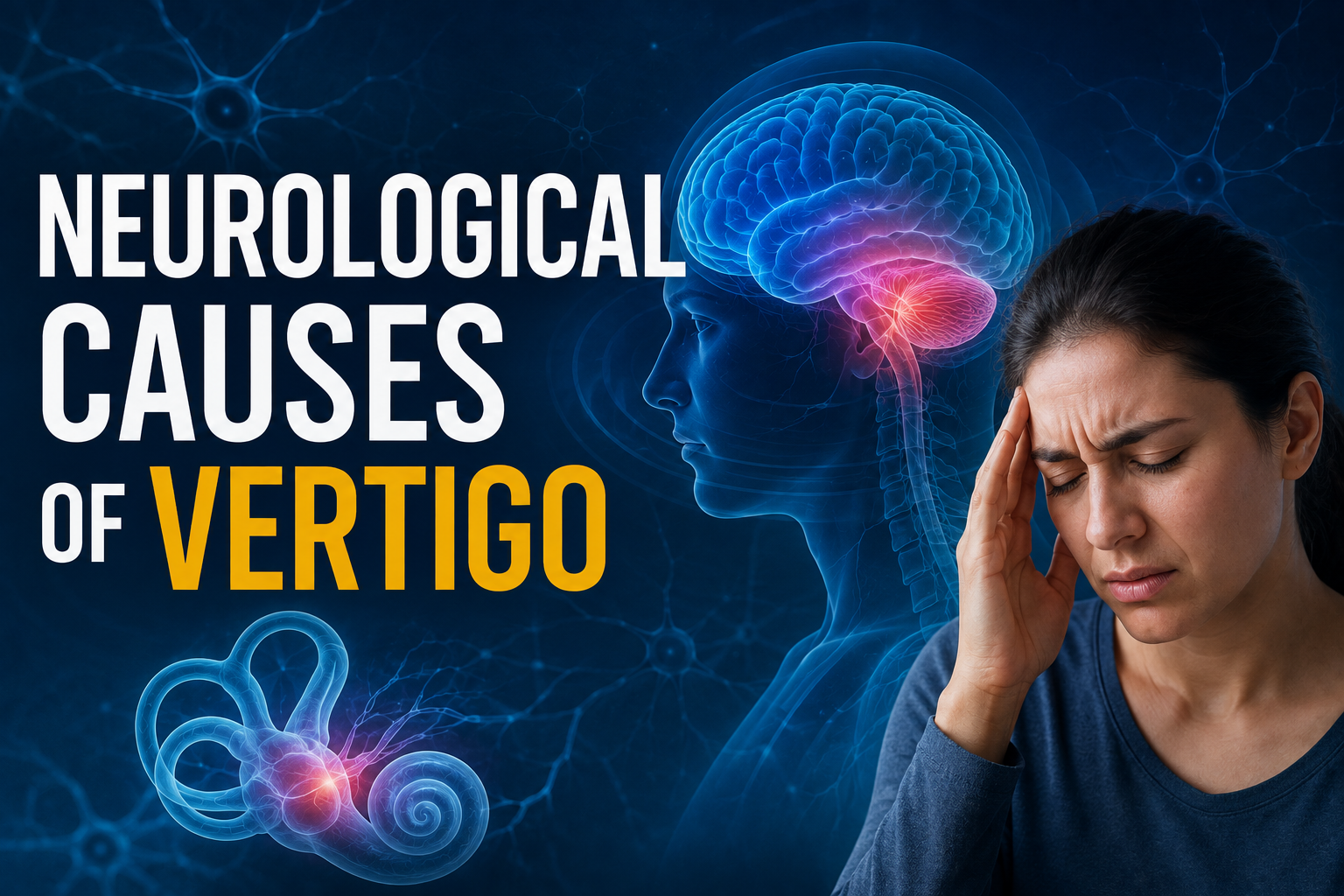
Vertigo Feeling: Is It Coming from Your Brain or Ear
Neurological causes of vertigo: Most people who feel the room spin assume it’s their inner ear — and most of the time, they’re right. But a smaller, more important subset of vertigo cases originates not in the ear at all, but in the brain itself. Distinguishing between the two isn’t a technicality for specialists; it’s one of the most clinically urgent distinctions in neurology, because a missed central cause can mean a missed stroke.
Quick self-check: Notice the fuller picture around your vertigo, not just the spinning itself —
- Did the vertigo come on suddenly and severely, and are you unable to stand or walk without support?
- Do you have any new slurred speech, double vision, facial drooping, or weakness/numbness on one side?
- Is there a headache unlike any you’ve had before, paired with the dizziness?
- Do you have vascular risk factors — high blood pressure, atrial fibrillation, diabetes, or a smoking history?
If you’re answering yes to several of these, this isn’t a wait-and-see situation — it warrants emergency evaluation, which we’ll come back to.
Central vs. Peripheral: Why the Distinction Matters So Much
Vertigo is broadly split into two categories. Peripheral vertigo — the far more common type — stems from the inner ear’s vestibular system: conditions like BPPV, vestibular neuritis, or Ménière’s disease. Central vertigo arises from dysfunction in the brainstem, cerebellum, or their neural connections — the parts of the nervous system responsible for processing balance and spatial orientation. The same symptom, spinning, can come from either — but only one of them can be a stroke in progress.
The Neurological Causes of Vertigo
- Stroke — Ischemia affecting the cerebellum, brainstem, or vestibular nuclei is a leading central cause, particularly in older adults with vascular risk factors. Because the vertebrobasilar arterial system supplies both central structures and the inner ear, a blockage can actually produce either central or peripheral symptoms depending on exactly which vessel is affected — part of why this distinction can be genuinely difficult even for experienced clinicians.
- Multiple sclerosis — In younger patients, acute demyelination is a more common driver of central vertigo than vascular causes, often as an early or presenting symptom.
- Vestibular migraine — A frequently underrecognized cause where migraine mechanisms directly trigger vertigo episodes, sometimes without a typical headache accompanying it.
- Brain tumors — Growths that compress central vestibular structures can produce gradual-onset vertigo, typically alongside other slowly progressive neurological signs.
- Head injury and infection — Trauma or illness affecting brainstem or cerebellar function can also present with central vertigo.
A case worth knowing about: researchers have documented instances of labyrinthine infarction — a stroke affecting the blood supply to the inner ear itself — that mimics peripheral vestibular neuritis almost perfectly, arriving without the classic neurological red flags. It’s a striking reminder that “no obvious neurological signs” doesn’t always mean “not neurological.”
Reflect for a Moment
Have you or a doctor ever assumed your vertigo was “just inner ear” without a closer look at the fuller clinical picture — your gait, your eye movements, your neurological exam? For most people, that assumption is correct. But it’s worth knowing that a proper distinction relies on more than the spinning sensation alone.
How Clinicians Actually Tell Them Apart
Beyond imaging, bedside examination carries real diagnostic weight. Signs pointing toward a central cause include severe gait and truncal instability (an inability to stand unsupported), specific abnormal eye movement patterns, and new-onset hearing loss occurring alongside neurological signs. Emerging research is also examining biological markers — recent studies have found inflammatory signaling differences between central and peripheral vertigo, suggesting the two may eventually be distinguishable through blood-based markers in addition to clinical exam and imaging.
When This Becomes an Emergency
Sudden, severe vertigo combined with any focal neurological symptom — slurred speech, facial asymmetry, limb weakness, double vision, or an inability to walk unaided — should prompt an emergency room visit, not a wait-and-see approach. Central causes, especially stroke, are time-sensitive in a way peripheral vertigo simply isn’t.
Treatment Follows the Underlying Cause
Central vertigo is managed by treating its root: emergency stroke protocols when ischemia is confirmed, disease-modifying therapy for multiple sclerosis, migraine-preventive strategies for vestibular migraine, or tumor-specific treatment when a growth is identified. Unlike peripheral vertigo, where repositioning maneuvers or vestibular rehabilitation are often the mainstay, central vertigo treatment is inseparable from treating the neurological condition driving it.
The Bottom Line
Most vertigo is peripheral and resolves with time or targeted rehabilitation. But because central vertigo can signal a stroke, MS, or another significant neurological process, the accompanying symptoms — not just the spinning — are what deserve your closest attention.
One question worth remembering: If your vertigo ever arrives with sudden weakness, slurred speech, or an inability to stand — will you treat that as an emergency, or wait to see if it passes?