
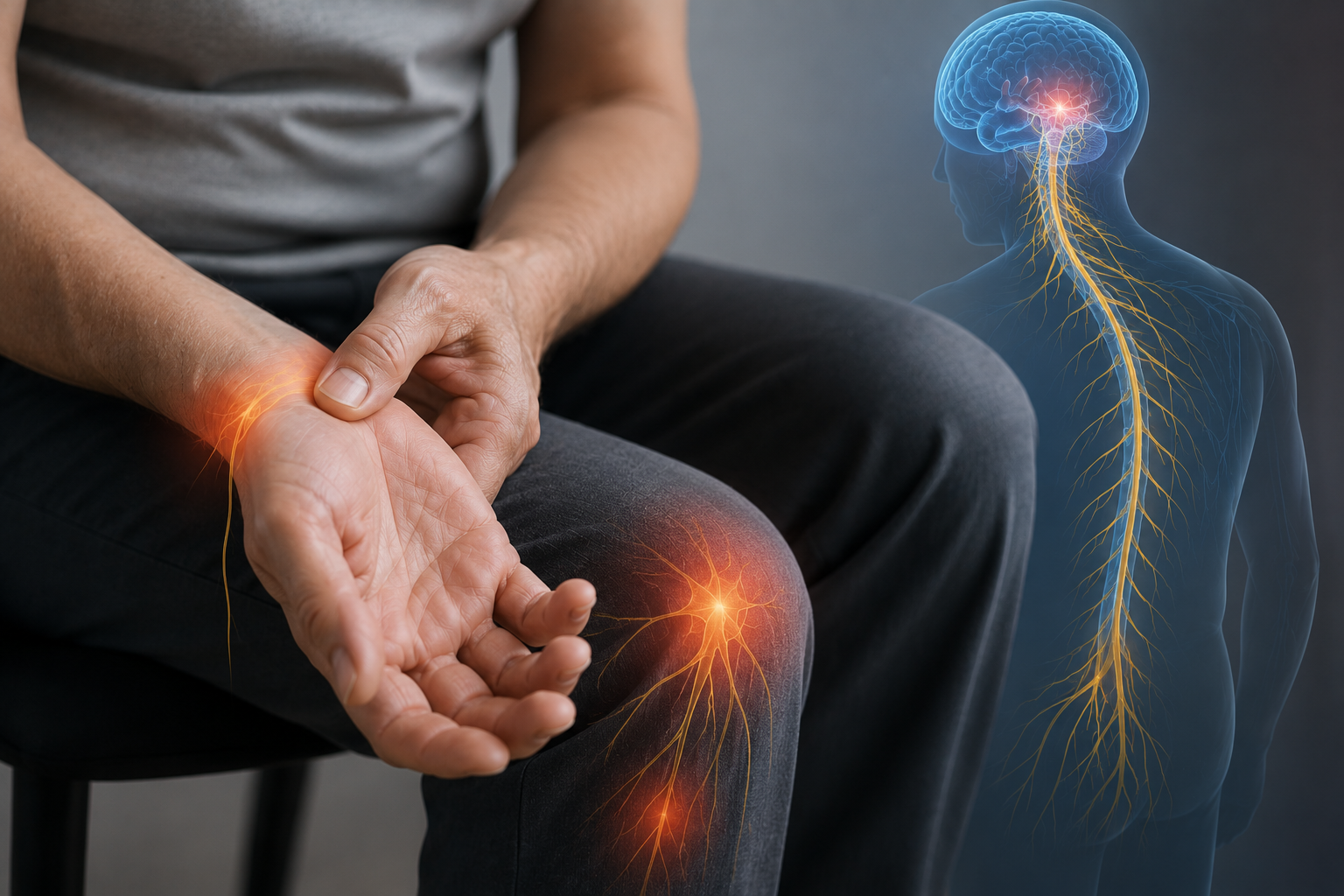
Not all “weakness” is the same — and that distinction matters more than most people realize. Struggling to open a jar because your grip has genuinely lost strength is a very different problem from feeling too fatigued to bother. True muscle weakness is measurable and specific, and neurologists say the pattern it follows — which limbs, which side, how it developed — is often the single biggest clue to what’s actually going on underneath.
Quick self-check: Before anything else, get specific about your pattern —
- Did the weakness appear suddenly (minutes to hours), or has it crept in over weeks or months?
- Is it on one side of your body only (one arm and one leg together), or symmetrical on both sides?
- Does it start distally — hands and feet — or closer to your shoulders and hips?
- Is it paired with numbness, tingling, or is strength the only thing affected?
Hold onto your answers — they map directly onto the causes below.
Why Pattern Matters More Than the Symptom Itself
Voluntary movement travels a specific path: from the motor cortex in your brain, down through the spinal cord, and out through peripheral nerves to your muscles. A problem anywhere along that path can cause weakness — but where the problem sits changes everything else about how it presents. That’s why clinicians don’t just ask “are you weak” — they map the weakness like a diagnostic clue.
Reading the Map: What Different Patterns Suggest
One side of the body — face, arm, and leg together. This pattern, especially if sudden, is the hallmark of a stroke affecting the opposite side of the brain. This combination is a medical emergency: sudden one-sided weakness, especially with facial drooping, slurred speech, or vision changes, warrants an immediate emergency room visit — not a wait-and-see approach.
Weakness starting in the hands and feet, both sides, gradually. This “stocking-glove” pattern, often with numbness alongside it, points toward a peripheral nerve disorder — commonly diabetic neuropathy, but also nutritional deficiencies, alcohol-related nerve damage, or autoimmune nerve conditions. People often first notice it as difficulty buttoning a shirt, gripping a cup, or stepping over a curb.
Weakness with muscle cramping, twitching, and no sensory loss. Weakness paired with visible muscle twitching (fasciculations), cramping after movement, and progressive atrophy — without numbness — is a distinctive pattern that always warrants prompt neurological evaluation, since it can reflect motor neuron involvement rather than a purely peripheral or muscular cause.
Weakness with back pain and bowel or bladder changes. This combination suggests possible spinal cord involvement — from disc disease to, in people with a cancer history, spinal metastasis putting pressure on the cord. This is another pattern that needs urgent, not routine, evaluation.
Reflect for a moment: Which of these patterns is closest to what you’re noticing? That single observation is often more clinically useful than describing “how weak” something feels.
Getting an Accurate Diagnosis
Because the potential causes span the brain, spinal cord, peripheral nerves, and muscles themselves, evaluation typically starts with a detailed neurological exam — checking reflexes, muscle tone, and how you walk — followed by targeted testing: blood work for diabetes, thyroid function, and vitamin B12; electromyography (EMG) and nerve conduction studies to assess nerve and muscle electrical activity; and MRI of the brain or spine when a central cause is suspected.
Treatment Follows the Cause, Not the Symptom
- Stroke-related weakness: Time-sensitive emergency treatment first, followed by structured rehabilitation — physical and occupational therapy remain central to regaining function.
- Peripheral neuropathy: Managing the underlying driver (blood sugar control, vitamin repletion, reducing alcohol intake) alongside nerve-focused rehabilitation.
- Nerve compression (spine-related): Physical therapy, and in select cases, surgical decompression when structural pressure is confirmed.
- Motor neuron or muscular causes: Managed by a neurologist with a treatment plan specific to the confirmed diagnosis, since these conditions vary widely in course and management.
The Bottom Line
Weakness in hands and legs is never something to diagnose from a search engine alone — but understanding your own pattern gives you a genuinely useful head start on the conversation with your doctor. Sudden, one-sided weakness is always an emergency. Gradual, symmetrical weakness deserves a prompt, thorough workup rather than months of “waiting to see.”
One question worth answering honestly: If you had to describe your weakness in hands and legs using just the four questions above, would you say it’s something you’ve been quietly monitoring — or something you’ve been putting off mentioning?