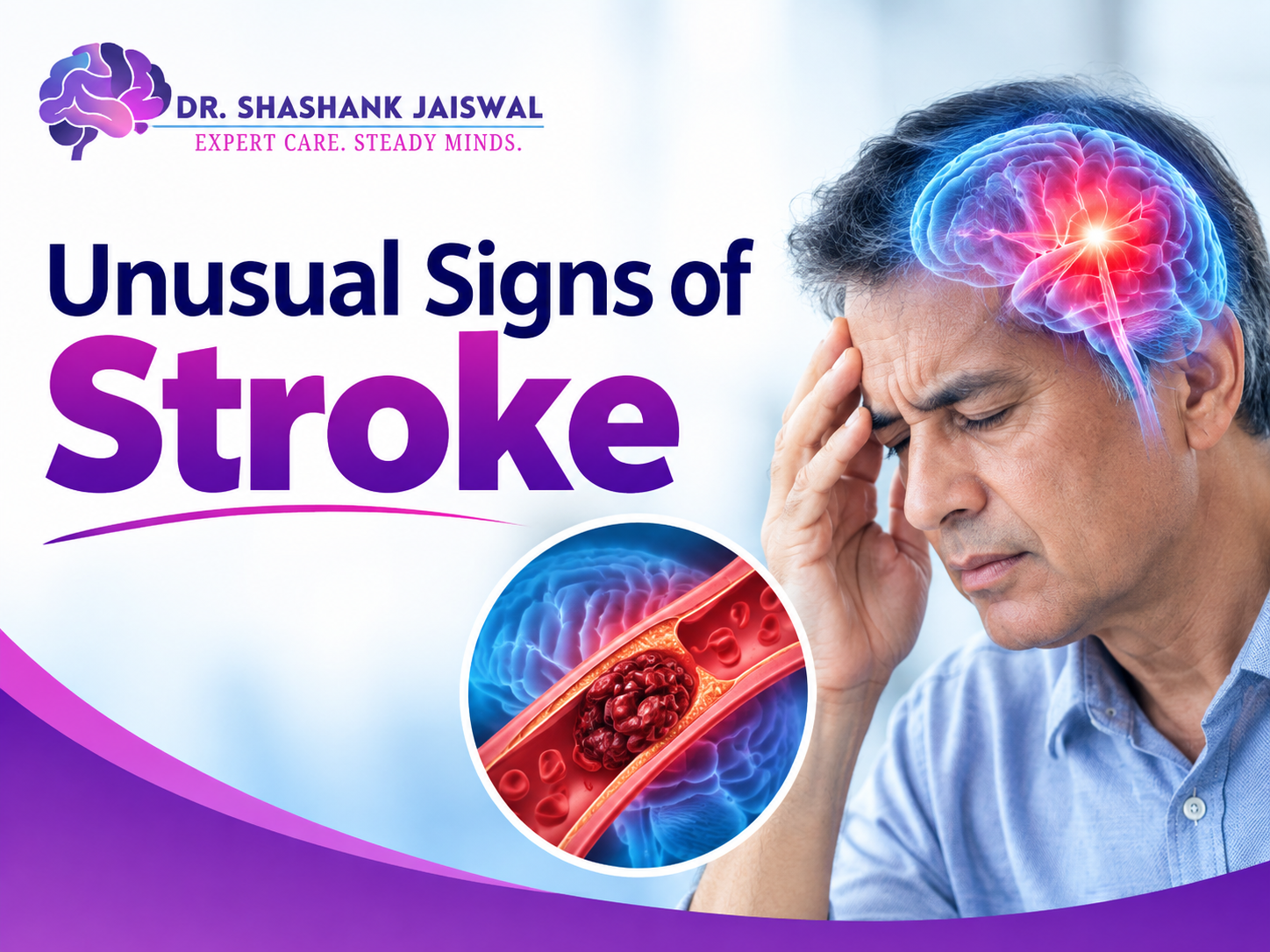
Unusual Signs of Stroke: When It’s Not FAST
Unusual signs of stroke: Everyone’s heard of F.A.S.T. — face drooping, arm weakness, speech difficulty, time to call emergency services. It’s a genuinely effective public health tool, and it correctly identifies a large share of strokes. But a growing body of recent research has quantified something stroke specialists have long suspected: a substantial share of strokes doesn’t look like that at all. A 2025 study using diffusion-weighted MRI found that among patients with confirmed acute brain ischemia, roughly 38% presented with symptoms that didn’t fit the standard clinical definitions of stroke or transient ischemic attack. That’s not a rare edge case — it’s more than one in three.
Let’s take a quick look at the unusual signs of stroke.
Quick self-check: If you or someone near you suddenly develops any of the following, treat it with the same urgency as classic stroke signs —
- A sudden, severe headache unlike any you’ve had before
- Sudden confusion, disorientation, or difficulty understanding speech
- Sudden dizziness, loss of balance, or a spinning vertigo-like sensation
- Sudden vision changes — double vision, blurring, or partial vision loss
- Nausea or vomiting with no clear cause, especially alongside any of the above
None of these fit the classic checklist neatly — and that’s precisely the point.
Why “Unusual Signs of Stroke” Doesn’t Mean “Rare Cause”
Atypical presentations often trace back to where in the brain the stroke occurs, not to some exotic underlying mechanism. Strokes affecting the back of the brain — the posterior circulation, supplied by the vertebrobasilar arterial system — are especially prone to producing symptoms that don’t match the classic checklist. This region controls balance, coordination, and specific cranial nerve functions, which is why posterior circulation strokes commonly present with vertigo, nausea and vomiting, double vision, difficulty swallowing or speaking, and even brief episodes of lost consciousness, sometimes without any of the limb weakness people associate with stroke.
The Case Reports That Illustrate Just How Varied This Gets
Reflect for a moment: Would you recognize any of the following as a possible stroke symptom, rather than something more mundane?
A review of documented stroke case reports found patients presenting with genuinely surprising initial complaints: sudden hearing loss, isolated drooping of one eyelid, a persistent cough, a sensation of something stuck in the throat, disrupted sleep, chest pain, limb pain, foot drop, and even psychosis. In several of these cases, the unusual symptom actively misdirected the initial diagnostic workup toward a cardiac, ENT, or psychiatric cause before stroke was eventually recognized. Vision problems deserve particular attention here — strokes affecting the artery supplying the brain’s visual processing center can cause patients to lose awareness of one side of their visual field entirely, sometimes literally walking into walls or grooming only half their face without registering the deficit.
Who’s More Likely to Present Atypically
Research specifically examining who reports atypical stroke symptoms has identified meaningful patterns. A study from Denmark found that women had notably higher odds than men of presenting with atypical symptoms such as loss of consciousness and nausea or vomiting, while showing lower odds of the “classic” lower-limb weakness pattern. The same research found age plays a role too — older patients were somewhat less likely to report sensory changes but more likely to experience swallowing difficulty, while younger patients more frequently reported atypical symptoms overall. This has a real practical consequence: atypical presentation, more common in women and younger patients, is specifically linked to delayed recognition and delayed treatment.
Why This Actually Changes the Stakes
Reflect for a moment: Time-sensitive stroke treatments are most effective within a narrow treatment window. An unusual symptom that gets attributed to migraine, anxiety, inner-ear trouble, or a pinched nerve can consume exactly the hours where intervention matters most.
What This Means in Practice
None of this replaces F.A.S.T. or BE-FAST as a first-line public awareness tool — those signs remain the most common presentation and deserve immediate action every time. But recognizing that sudden, severe, out-of-character neurological or sensory symptoms — even without limb weakness or facial drooping — warrant the same emergency response is a genuinely underappreciated piece of stroke education.
The Bottom Line
Strokes don’t always look like the textbook picture. Sudden vertigo, an unexplained severe headache, sudden confusion, or unusual vision changes deserve the same urgency as classic signs — especially in women, younger patients, and anyone with vascular risk factors.
One question worth remembering: If a sudden, strange neurological symptom appeared today — one that didn’t look like “textbook stroke” — would you treat it as an emergency, or wait to see if it passed?