Cluster Headaches: The Most Intense Headache You’ve Probably Never Heard Of
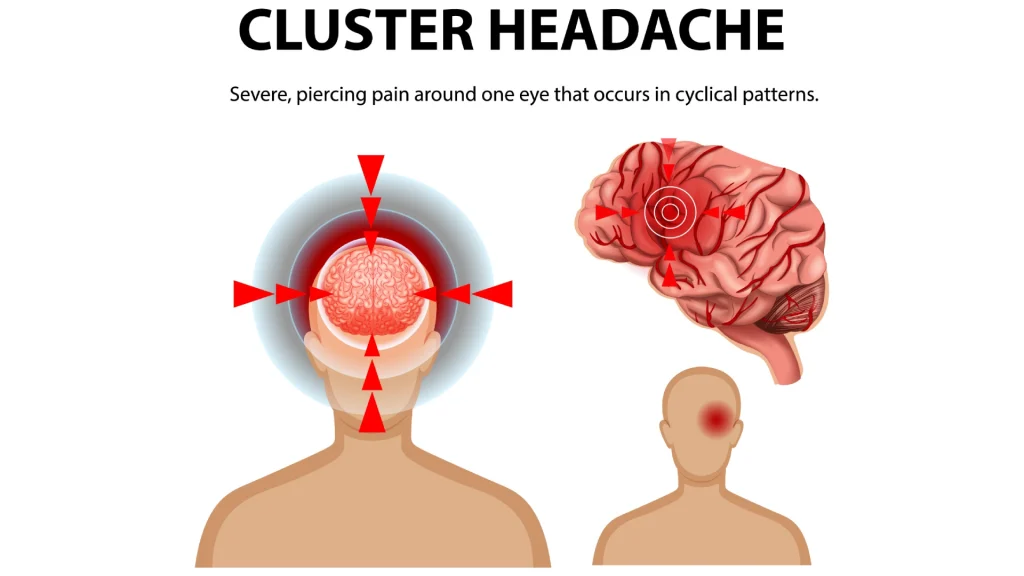
Do you have a headache that is quite severe and wakes you from deep sleep, strikes without warning, and makes it impossible to sit still?
Remember! This is not a migraine, neither a tension headache nor a sinus headache. This is a cluster headache—one of the most painful neurological conditions known.
Despite its intensity, cluster headache remains widely misunderstood and often misdiagnosed.
What Are Cluster Headaches?
Cluster headaches are a primary headache disorder characterized by short-lasting but extremely severe attacks that occur in groups, or “clusters.” These clusters can last weeks to months, followed by periods of complete relief.
In a typical cluster headache episode, the pain is:
- Unilateral (on one side of the head)
- Centered around or behind one eye
- Sudden and rapidly escalating
- Often described as burning, piercing, stabbing, or drilling
Patients frequently say it feels as though “something is attacking the eye from the inside.”
Why Are They Called “Cluster” Headaches?
Cluster headaches are so-called because the attacks are not random.
They occur:
- Multiple times a day (often 1–8 attacks daily)
- At the same time each day or night
- For weeks or months in a row
After a cluster period ends, the headache may disappear entirely for months or even years—only to return.
This clock-like regularity is one of the defining features of cluster headaches.
The Distinctive Symptoms You Cannot Ignore
Cluster headaches come with unmistakable physical signs on the same side as the pain, including:
- Red, watery eye
- Drooping eyelid
- Swelling around the eye
- Stuffy or runny nose
- Facial sweating
Unlike migraine sufferers, people with cluster headaches often feel restless or agitated, pacing the room or rocking during an attack. Lying down usually makes it worse.
What Causes Cluster Headaches?
The exact cause is still being studied, but strong evidence points to dysfunction in the hypothalamus, the part of the brain that controls:
- Biological clock
- Sleep–wake cycles
- Hormonal rhythms
This explains why attacks often:
- Occur at night
- Follow seasonal patterns
- Strike at the same hour daily
Cluster headaches also involve activation of the trigeminal nerve, which is responsible for facial sensation and pain.
Who Is Most at Risk?
Cluster headaches are rare but more common in:
- Men (though women are increasingly diagnosed)
- Adults between 20–50 years
- Smokers or those with a history of smoking
- Individuals with disrupted sleep patterns
Importantly, cluster headaches are not stress-related and not caused by high blood pressure or vision problems, despite common assumptions.
Triggers That Can Set Off an Attack
During an active cluster period, certain factors can trigger an attack almost immediately:
- Alcohol (a very strong trigger)
- Strong smells (petrol, perfumes, solvents)
- High altitude or air travel
- Irregular sleep or naps
Outside a cluster period, these triggers may have no effect.
How Are Cluster Headaches Diagnosed?
There is no single lab test. Diagnosis is based on:
- Detailed headache history
- Symptom pattern and timing
- Neurological evaluation
Imaging studies may be used to rule out secondary causes, especially in first-time or atypical cases.
Treatment: Why Speed Matters
Cluster headaches demand fast-acting treatment. Regular painkillers are usually ineffective due to the sudden onset and intensity.
Management focuses on:
- Rapid relief during attacks
- Preventive therapy to shorten the cluster cycle
- Avoidance of known triggers
Early diagnosis and expert care can dramatically reduce both pain intensity and frequency.
When to Seek Immediate Medical Attention
Do not ignore headaches that:
- Wake you from sleep repeatedly
- Cause severe one-sided eye pain
- Are associated with eye redness or nasal symptoms
- Occur in predictable daily patterns
These are red flags that require neurological evaluation.
Living With Cluster Headaches
Cluster headaches can be physically and emotionally exhausting. Many patients describe them as isolating because the pain is invisible yet overwhelming.
Understanding the condition is the first step toward regaining control.
The Final Word
Cluster headaches are rare, severe, and life-disrupting—but they are treatable.
The key lies in recognition, timely diagnosis, and expert management.
If headaches are controlling your schedule instead of the other way around, it is time to listen to what your brain is trying to tell you.
Because pain this precise is never random—and never something you should endure alone.